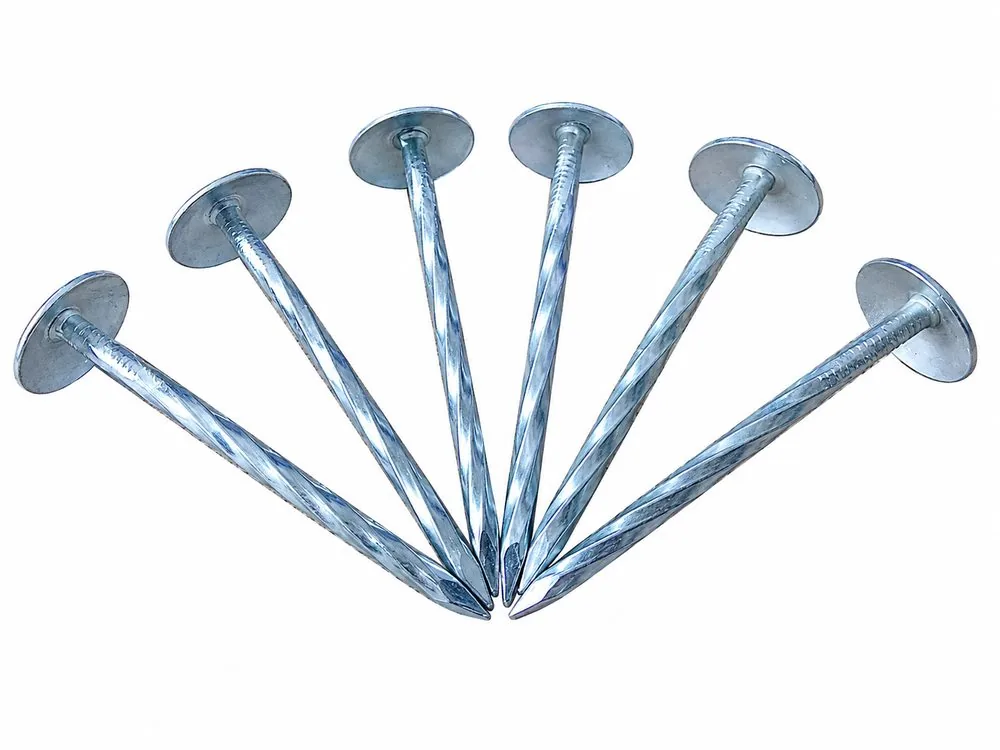
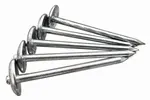
With or Without Rubber Washer
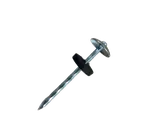
The two versions exist for two different jobs. The rubber-washer nail is the roofing nail proper: the washer compresses over the drilled hole as the nail is driven home, sealing the penetration against water tracking back along the shank. Without it, a corrugated roof leaks at every fixing point.
The nail without a washer is the general-purpose fastener — fencing, timber framing, fixing sheets where sealing is not the job. Both are galvanized steel, so they hold up in weather without rust streaking down the surface.
Smooth Shank or Screw Shank
Roofing nails come in two shank styles, and the choice is about pull-out force. The smooth shank drives in faster and is the standard version for general roofing work. The screw shank — also called ring or annular shank — carries spiral or ringed barbs along the shank that bite into the timber, so the fixing resists uplift far better.
For windy regions and exposed sites, screw shank is the version distributors recommend; on large roofs where installation speed decides labour cost, smooth shank keeps the crew moving. Both are supplied with the same umbrella head and the same finish options.
Steel, Head and Finish
Roofing nails are made from cold-drawn low-carbon steel wire, headed with a pressed steel sheet cap in one piece. Q195 wire is the mainstream choice for value; Q235 is specified where a harder shank is wanted. For coastal projects where salt air kills ordinary galvanized nails within a few seasons, 304 and 316 stainless versions are available.
The umbrella head is the detail that makes the nail a roofing nail: its wide cap spreads the hammer force across the corrugated sheet so the tile is not cracked at the fixing point.
Two galvanized finishes cover the trade:
- Electro-galvanized (EG) — blue-white or color zinc, economical, for ordinary outdoor exposure; the highest-volume finish for Southeast Asia and Africa
- Hot-dip galvanized (HDG) — a thick zinc layer for rainy and coastal sites; the preference in South America and the Middle East
The EPDM rubber washer is fitted over the shank and compresses as the nail is driven home, sealing the drilled hole against leaks.
Sizes — BWG and Millimetre, Dual Standard
Diameters run 2.5 / 2.8 / 3.0 / 3.4 / 3.8 / 4.0 mm, which corresponds to BWG12 through BWG8. Lengths run 25 to 100 mm — the same nails are marked in inches from 1.5" to 4", and most export orders are placed in the inch standard.
The sizes that move in volume are 9BWG × 2", 9BWG × 2.5" and 8BWG × 3". Any size outside this range can be produced to order — send the size list your market uses with the inquiry.
Where Roofing Nails Are Used
Washered nails go wherever sheets are fastened to a structure: corrugated steel and tile roofs, asphalt shingles, felt underlay and roofing membranes, driven into wooden purlins and joists. Factories, warehouses, canopies and self-built housing are the typical projects; the plain version covers the general fixing that surrounds the same jobs — fencing, crates and timber components.
For distributors, the pairing is practical: roofing accounts take the washered version in volume, and hardware retail takes both — the washer version as a roofing line, the plain version as a box-nail substitute.
- Roofing — corrugated sheets, shingles, felt underlay and membrane fixing
- Fencing — wire and mesh fencing, gate and post fixing
- Timber framing — general construction fixing where sealing is not required
- Cladding — sheet fixing to frames and purlins
Packing Options
Three packing formats cover the trade:
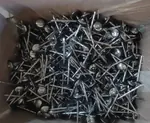
- Bulk for full-container wholesale — 25 kg cartons or 50 kg woven bags, the standard format for South America and Africa
- Retail boxes — 1 kg or 7 lb boxes, 8 boxes to an outer carton, for supermarkets and hardware retail
- Palletized — cartons or bags stacked, stretch-wrapped and banded, to survive sea freight without damage
OEM is available: customer logo color boxes and private-label packing can be arranged together with the size list.
Export Markets
These nails move mainly to South America — Brazil, Peru, Chile and Colombia, where hot-dip galvanized is specified for the rainy and coastal zones — and to Africa, where Ghana, Nigeria, Kenya, Tanzania and Cote d'Ivoire take electro-galvanized in container volume. Southeast Asia (Indonesia, Malaysia, the Philippines and Vietnam) and the Middle East (Saudi Arabia, the UAE and Jordan) are steady markets, and Central America and the Caribbean take smaller volumes, preferring hot-dip or stainless for coastal exposure.
Roofing Nails — FAQ
What is the difference between the two versions?
The rubber washer seals the drilled hole against leaks for roofing; the version without a washer is for general fixing.
What is the difference between smooth shank and screw shank?
A smooth shank drives faster and suits general roofing; a screw shank carries ringed barbs that bite into the timber and resist pull-out, which is why windy regions specify it.
What sizes can you supply?
Diameters from 2.5 to 4.0 mm (BWG12 to BWG8) and lengths from 25 to 100 mm, marked 1.5" to 4". The volume sizes are 9BWG × 2", 9BWG × 2.5" and 8BWG × 3"; custom sizes are produced to your list.
Which finish should I choose — electro-galvanized or hot-dip?
Electro-galvanized (blue-white or color zinc) is the economical choice for ordinary outdoor exposure; hot-dip carries a much thicker zinc layer and is specified for rainy and coastal sites.
Do you supply retail box packing or OEM packing?
Yes — 1 kg or 7 lb retail boxes (8 per outer carton) for hardware retail, and logo color boxes or private-label packing on request, alongside the standard 25 kg carton and 50 kg bag bulk formats.
What is the MOQ and packing?
MOQ is 1 ton per SKU; standard packing is 25KG per carton, custom packing on request.