Hardened to Drive Into Masonry
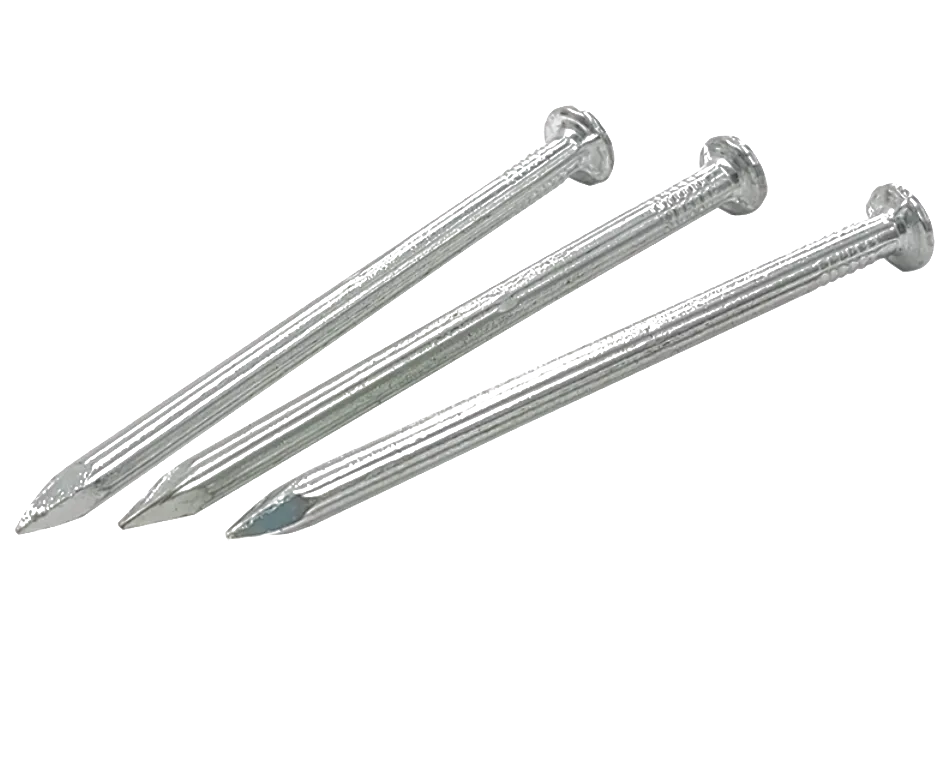
Concrete nails are hardened steel, not ordinary wire — the hardening is what lets the nail bite into concrete and masonry instead of bending. A standard nail hit against a block wall folds; these are driven straight in with a hammer or a powder-actuated tool, no pre-drilled hole required.
Two finishes cover the usual specifications: galvanized (GI) for general and exterior work, black for positions where the nail is not seen or is finished over afterwards.
Concrete Nail vs Wire Nail — Not the Same Nail
In everyday speech both products get called "iron nails", but they are not the same nail. The concrete nail is quenched, hardened medium-to-high carbon steel; the common wire nail is soft, unquenched low-carbon steel. That difference is not branding — it decides what each nail can be driven into.
A wire nail folds the first time it is hit against a wall. A concrete nail drives straight into concrete, block and brick — but it is hard and brittle, so a heavy wild blow can snap it, and on timber it will split thin boards. Sending wire nails to a concrete job, or concrete nails to a joinery shop, is the most common mix-up in this category.
- Material — concrete: quenched 45# / 55# / 60# carbon steel; wire: soft Q195 / Q235 low-carbon steel, never quenched
- Hardness — concrete: HRC 50-58, hard but brittle; wire: HB≈100-180, bends 90° without breaking
- Shank — concrete: plain, helically or straight fluted (better grip in concrete), diamond point; wire: smooth round shank, standard point
- Core use — concrete: fixing timber grounds, cable trays and clips to concrete, brick, block and mortar; wire: timber framing, crates, pallets and furniture — timber and soft board only
- Limits — concrete: splits thin boards, not a woodworking nail; wire: cannot be driven into concrete or masonry at all
Steel Grade, Hardness and Shank Style
The grade is the product. Concrete nails are made from 45#, 55# or 60# medium-to-high carbon steel and must go through quench heat treatment — without the quench the steel stays soft and the nail bends instead of biting. After treatment the nail sits at HRC 50-58: hard enough that concrete and brick do not deflect it, brittle enough that it should be struck straight rather than pried.
Shank style is chosen by grip. The plain shank is the general-purpose version; fluted shanks — helical or straight grooves — hold more strongly in concrete because the groove keys into the masonry as the nail is driven. The diamond point concentrates the strike so the nail starts into hard base material without skating.
- Plain shank — general-purpose fixing in concrete and block
- Fluted shank (helical or straight) — extra grip in concrete; the standard choice for heavy fixings
- Diamond point — self-starting tip for hard base material
Finishes for Concrete Nails
Electro zinc (bright silver) is the volume finish and the default for most export orders. Blackened or blued is the low-cost option where appearance does not matter; yellow zinc gives better corrosion protection at a small premium; phosphating (grey) is specified where the nail is finished over or needs a coating-ready surface.
On the trade side, concrete nails are the premium line in a fastener range — higher unit price than wire nails, with steady demand from construction, water and electrical contractors in the Middle East and Africa. Those buyers usually take GI as the standard and black for concealed work.
- Electro zinc — bright silver finish; the best seller for export
- Blackened / blued — low-cost finish for unseen positions
- Yellow zinc — better rust protection at a small premium
- Phosphated (grey) — matte finish for coated or finished-over positions
Where Concrete Nails Are Used
They are the fixings-of-first-resort on any concrete or masonry job: furring strips and battens on block walls, electrical boxes and cable clips, skirting and trim, signage brackets, temporary formwork and shuttering.
Because the nail is hammered rather than drilled and plugged, it is also the fast fixing on sites where drilling access is awkward or a plug-and-screw detail is overkill.
- Concrete & block walls — battens, furring strips, skirting and trim
- Electrical — boxes, cable clips and conduit on masonry
- Signage & fixtures — brackets, nameplates and light fixings
- Temporary works — formwork, shuttering and site fixings
Packing & Program Notes
Assorted sizes are the standard packing, with 25KG per carton as the norm — custom packing is available where a market expects a different format.
MOQ is 1 ton per SKU. Custom size runs can be produced against specification; send the size list and finish your project uses.
Concrete Nails — FAQ
Do these nails need pre-drilling?
No. The hardened steel is driven directly into concrete and masonry with a hammer.
What finishes are available?
Galvanized (GI) and black.
What sizes do you supply?
Assorted sizes as standard, with custom size runs against your specification.
What is the MOQ and packing?
MOQ is 1 ton per SKU; standard packing is 25KG per carton, custom on request.
How is a concrete nail different from a common wire nail?
A concrete nail is quenched medium-to-high carbon steel (45# / 55# / 60#) hardened to HRC 50-58 for driving into masonry; a wire nail is soft low-carbon steel for timber and folds against a wall.
Can concrete nails be used on timber?
Not for joinery — the hardened steel splits thin boards. Concrete nails are for fixing to concrete, brick and block.