Single-Side Fastening — Why Blind Rivets
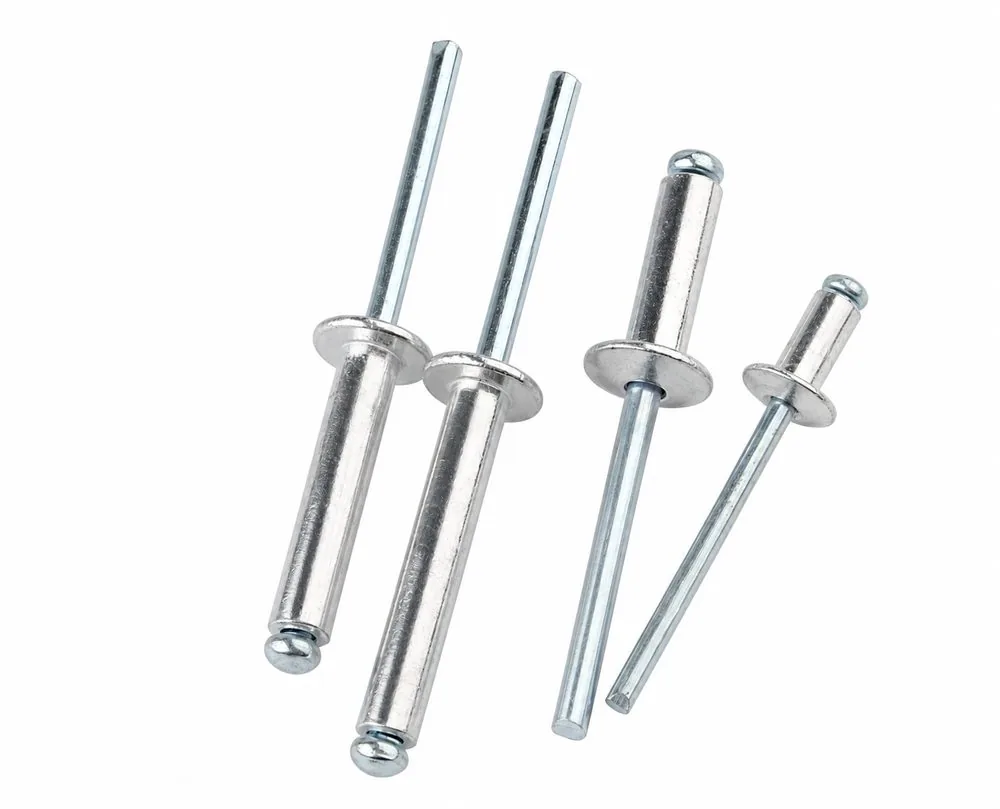
The blind rivet — pop rivet — exists for one reason: it installs from one side only. The mandrel is pulled by a rivet gun, the body expands on the blind side and locks the sheets together permanently. No bucking bar, no second pair of hands behind the panel.
That single-side capability is what put blind rivets into every sheet-metal trade: anything assembled in a cabinet shop, on a truck body line or on site where the back of the joint cannot be reached. The joint is permanent — for a fixing that has to come apart again, use screws.
Body and Mandrel Materials
Blind rivets are specified as body/mandrel combinations, and the combination decides both price and performance:
- Aluminium / aluminium (Alu/Alu) — the volume version: light, easy to pull, rust-resistant enough for indoor and sheltered work, lowest cost. First choice for signs, cabinets and thin aluminium sheet.
- Aluminium / steel (Alu/Steel) — higher pull load at close to the same price; the value upgrade when the joint carries more than signage weight.
- Steel / steel, zinc plated — the strongest of the common combinations, but it rusts; used for indoor sheet metal where corrosion is not a factor.
- SS304 stainless — outdoor and rain-exposed work.
- SS316 stainless — coastal and marine sites where salt spray kills lesser finishes; the most expensive of the standard range.
- Brass / copper — decorative, electrical and leather-goods work: good looking, corrosion resistant, and conductive.
Surface Finishes
- Electro-galvanized — blue-white or color zinc; the standard finish for steel rivets
- Polished bright — aluminium and brass versions
- Anodized aluminium — black, red, blue and yellow decorative rivets for cabinets, shelving and retail fittings; the colored versions are popular with European and American supermarket fit-outs
- Passivation — stainless rivets, improves salt-spray resistance
- Dacromet — high-end corrosion protection
- Sealed (closed-end) — the tail is sealed after riveting, making the joint waterproof; used on color sheet, containers and anywhere water must not track through the hole
Sizes, Grip Range and Head Types
Diameters run 2.4 / 3.0 / 3.2 / 4.0 / 4.8 / 5.0 / 6.4 mm — the volume sizes are 3.2, 4.0 and 4.8. Lengths run 4 to 30 mm, and sizes are written as body diameter × overall length: 4.0 × 10 means a 4.0 mm body and 10 mm overall length.
The number that actually decides the order is the grip range — the total sheet thickness the rivet can clamp. Two joints with the same diameter can need different lengths, so confirm the stack thickness at the joint when ordering.
Three head types cover the trade:
- Round head — the general-purpose version
- Countersunk — sits flush with the surface after installation
- Large flange — for soft materials such as plastic and wood, so the head does not pull through
Solid and Semi-Tubular Rivets
Beyond blind rivets, solid and semi-tubular rivets cover the heavier end. Solid rivets run from 8 mm upward in steel and stainless and are set hot or pressed — they need access to both sides of the joint and are the standard for bridges, steel structures and heavy fabrication. Semi-tubular rivets, with a partial hole at the tail, are the version used for bags, shoe buckles, nameplates and leather goods, where a lighter set is enough.
Both are supplied, but export volume is a fraction of blind rivets — for most buyers the blind rivet is the product.
Where Blind Rivets Are Used
Blind rivets hold thin sheet to thin sheet, which puts them in the middle of most light-fabrication work:
- Sheet-metal fabrication — enclosures, machine cabinets, distribution boxes
- Signage and advertising — aluminum composite panels, sign frames
- Aluminum framing — profiles, shelving, workstations
- Transport — containers, bus and truck bodies, elevator panels, ventilation ducts
- Construction — color sheet, prefab houses, guardrails, solar mounting brackets
- Consumer goods — bags, leather goods, toys, furniture, lamp housings
- Sealed rivets — RVs, water tanks, canopies and outdoor equipment where the hole must not leak
Packing Options
- Bulk for factory customers and full containers — 5 / 10 / 25 kg cartons
- Retail boxes — 200 / 500 / 1000 pcs per box, in color boxes or transparent plastic boxes, for supermarkets and building-material stores
- Palletized — outer cartons stacked, stretch-wrapped and packed with moisture-proof bags, to survive sea freight
- OEM — customer logo color boxes and private-label packing
Export Markets
Southeast Asia — Indonesia, Malaysia, the Philippines and Vietnam — takes aluminium blind rivets in the largest volumes. West Africa (Nigeria, Ghana, Kenya, Cote d'Ivoire) moves standard aluminium and zinc-plated steel. South America (Brazil, Peru, Colombia) specifies stainless and sealed waterproof versions more often, and the Middle East (Saudi Arabia, the UAE, Jordan) buys outdoor corrosion-resistant finishes.
Rivets vs Roofing Nails — Not Interchangeable
Buyers often order both in the same shipment, and they do different jobs. A roofing nail is hammered into a wooden purlin to fix roof sheets — it is a nail, it can be pulled out, and it needs timber to bite. A blind rivet is a permanent joint for thin metal sheets, installed from one side with a pull gun; it cannot be driven into wood. See the roofing nail page for the nail side of the comparison.
Blind Rivets — FAQ
Which body material should I choose?
Aluminium/aluminium is the volume version for signs, cabinets and thin aluminium sheet; aluminium/steel takes more load; steel/steel is strongest but rusts, so it stays indoors; SS304 suits outdoor and rain; SS316 suits coastal salt spray; brass is for decorative, electrical and leather work.
What does grip range mean?
It is the total sheet thickness the rivet can clamp. Order by the stack thickness at the joint, not by diameter alone — 4.0 × 10 means a 4.0 mm body and 10 mm overall length.
Which head type should I choose?
Round head is the general-purpose version, countersunk sits flush with the surface, and large flange suits soft materials like plastic and wood so the head does not pull through.
What sizes do you supply?
Diameters 2.4 to 6.4 mm and lengths 4 to 30 mm; the volume sizes are 3.2, 4.0 and 4.8 mm, with custom sizes produced to your list.
Do you supply retail packing or OEM?
Yes — 200, 500 or 1000 pcs boxes in color or transparent plastic boxes for retail, and logo color boxes on request; factory orders ship in 5, 10 or 25 kg bulk cartons.
What is the MOQ and packing?
MOQ is 1 ton per SKU. Standard bulk packing is 5, 10 or 25 kg cartons; retail boxes of 200 / 500 / 1000 pcs are available as a packing option.