Choosing Nail Size
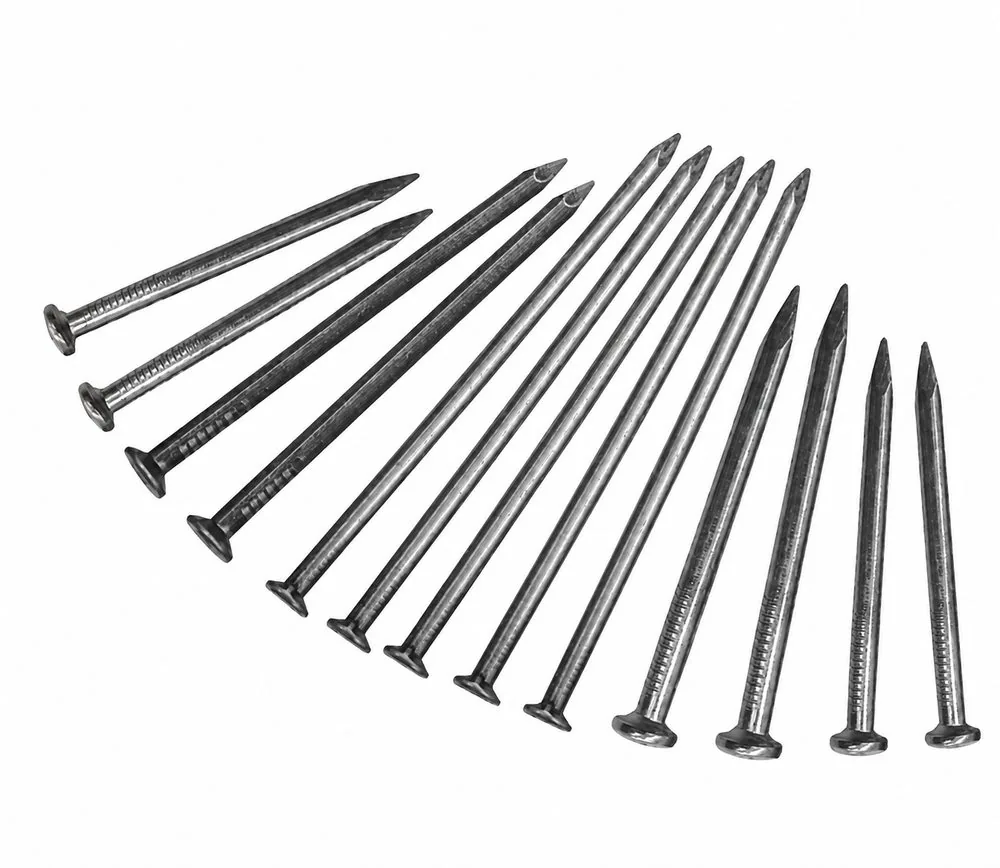
Common iron panel nails are sized by length and gauge (BWG). 1" suits trim and light fixing; 1.5"–2" covers general framing, joinery and fencing; 3"–4" is for heavy framing, decking and formwork. Each length is offered in a gauge band (for example 3" in BWG 12-8) so buyers can select the stiffness their application needs — thinner gauge for softwood to avoid splitting, thicker for hardwood and structural work.
Wire Nail vs Concrete Nail — Soft Steel for Timber
In everyday speech people call these "iron nails" and reach for them on every job — but strictly speaking the wire nail is soft steel, and that softness is exactly what makes it a woodworking nail. The concrete nail is the hardened one; the two are not interchangeable, and the mix-up shows up the moment the job changes material.
A wire nail is Q195 or Q235 low-carbon steel, never quenched. It bends 90° by hand without breaking, drives through timber, plywood and plasterboard cleanly, and is cheap enough that a crate shop reorders it by the ton. The same nail hit into a concrete wall folds on the first blow — for masonry, that is the concrete nail's job.
- Material — wire: Q195 / Q235 soft low-carbon steel, unquenched; concrete: quenched 45# / 55# / 60# carbon steel
- Hardness — wire: HB≈100-180, bends without breaking; concrete: HRC 50-58, hard and brittle
- Shank — wire: smooth round shank with a standard point; concrete: plain or fluted shank with a diamond point
- Core use — wire: timber framing, crates, pallets, furniture and plasterboard; concrete: masonry fixings only
- Limits — wire: cannot be driven into concrete, brick or block; concrete: splits thin boards
Soft Steel: Grade, Hardness and Why It Matters
The grade explains the price. Low-carbon Q195 / Q235 steel needs no heat treatment, which keeps the nail cheap and — more importantly — tough. It yields rather than snaps when bent, pried or clinched, and clinching matters in crate and pallet work, where the protruding point is hammered back into the wood; a hard nail would break instead of folding over.
Hardness sits around HB 100-180, against HRC 50-58 for a concrete nail. The practical read: if the fixing is timber or soft board, this is the nail; if it is concrete, brick or block, soft steel folds on the first strike.
Finishes and Trade Profile
Four finishes cover the range. Bright polished is the cheapest and the fastest to rust — the default for indoor and dry work. Electro zinc (white zinc) is the general outdoor upgrade. Hot-dip galvanized is the premium outdoor finish where long-term corrosion protection matters, and small volumes of yellow zinc and copper plating cover specialty orders.
On the trade side, wire nails are the volume line of a fastener range: low unit price, huge tonnage, and year-round repeat orders from crate makers, pallet producers and timber shops. Those same accounts usually buy concrete nails alongside for their site crews, which makes the two a natural pair in one order.
- Bright polished — cheapest, indoor and dry use, rusts fastest
- Electro zinc (white zinc) — general-purpose outdoor and damp use
- Hot-dip galvanized — premium outdoor finish, thickest zinc layer
- Yellow zinc / copper plating — small-volume specialty orders
Plain vs Galvanized
Plain nails are the economical choice for indoor and dry-use applications. Galvanized nails are specified for outdoor, damp or treated-timber use, where rust staining and corrosion matter — fencing, decking, exterior cladding. Both finishes share the same length and gauge range, packed 25 KG per carton (or 1 KG × 25 per carton). MOQ is 1 ton per SKU, which suits importers and building-supply distributors running container programs.
Iron Nails — FAQ
What lengths and gauges are available?
1", 1.5", 2", 3" and 4", each in the gauge band listed in the specification table (BWG 20-18 through BWG 9-5).
Which finish for outdoor use?
Galvanized — plain nails are for indoor and dry applications.
What is the MOQ and packing?
MOQ is 1 ton per SKU. Packed 25 KG per carton, or 1 KG × 25 per carton; custom size and packing available.
Can you do OEM / custom specifications?
Yes — custom size and packing are available; discuss your requirements with us.
Can wire nails be driven into concrete?
No — the soft steel folds on the first blow against a wall. Use concrete nails for masonry fixings.
What is the difference between a wire nail and a concrete nail?
A wire nail is soft low-carbon steel (Q195 / Q235) for timber and bends easily; a concrete nail is quenched hard steel (HRC 50-58) for masonry. They are not interchangeable.