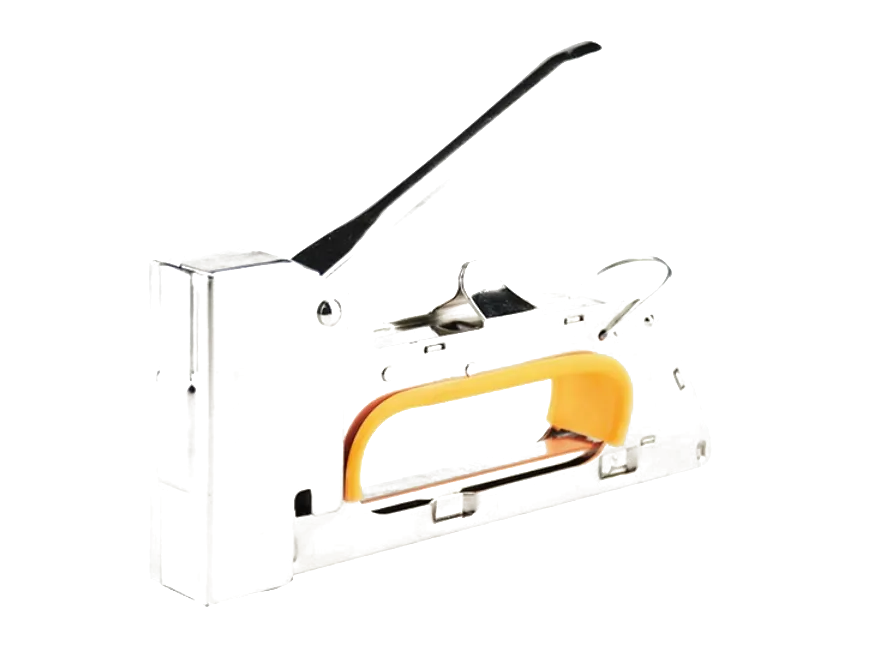
Steel Frame, Manual Drive
The frame is steel and the housing is ABS: the steel takes the spring load that makes a manual gun drive a staple home, and the ABS keeps the weight down for one-hand work overhead or under a bench. The needle and spring are spring steel, and the finish is painted and anti-rust treated. Economy models run the same ABS-housing build; the versions the DIY and building-materials channels ask for most are all-metal — cold-rolled steel, plated against rust — and buyers who use a gun daily take the extra weight without complaint.
Manual drive is the practical choice for most buyers — no air line, no compressor, no hose to drag across a job. The gun goes where the work is, which is why the manual format still outsells pneumatic staplers in the upholstery, wiring and packaging channels.
Three-Way: U Staples, Brads, T Pins
The export best-seller is the three-way head: one gun takes U-staples for webbing and mesh, straight brads for trim and cable runs, and T-pins for light fixing into wood. A shop that stocks one gun and three staple boxes covers upholstery, wiring and general repair without a second tool on the shelf.
Staple length runs 4–14MM — the range that covers most export demand. Light models sit at 4–8MM, heavy-duty builds reach 6–14MM, and the handle is about 16–18CM long. Every export model carries a safety lock: the tab that has to be squeezed before the gun fires. One limit to state plainly in any listing: this is a manual gun, and it drives into wood, plasterboard and thin plastic sheet — not concrete or thick steel.
Where Staple Guns Are Used
Upholstery shops use them for fabric and webbing; electricians secure cable runs with insulated staples; packaging departments close light cartons and staple corner protectors; and the DIY channel buys them for fencing, mesh and light repairs. Sign and banner shops staple advertising fabric to wooden frames, picture framers fix back boards, and hardware repair counters keep one behind the till for the customer who needs a staple driven today.
- Upholstery — fabric, webbing and trim work
- Electrical — securing cable runs with insulated staples
- Packing — light carton closing and corner protection
- Signs & banners — advertising fabric to wooden frames
- DIY & repair — fencing, mesh and general fixing
- Repair counters — kept behind the till as a counter tool
Packing & Program Notes
Retail packing is a single gun on a blister card or in a color box, usually with a small starter box of staples taped alongside — the pack that sells at the DIY counter. For export, guns go 10 to an inner box, and the outer carton runs 24 to 48 pieces depending on the model. Polybag, color box or blister packing can be arranged where the gun goes to the retail shelf.
MOQ is 10 cartons per SKU. Logo printing and custom packing open up from 50+ cartons for buyers with their own tool brand.
Staple Gun — FAQ
What type of staple gun is it?
Manual, standard model.
What is it made of?
Steel frame with ABS housing.
How is it packed?
24 to 48 pieces per carton in export cartons.
What staples does it take?
U-staples, straight brads and T-pins. The three-way head covers all three, which is why it is the export best-seller.
What materials can it drive into?
Wood, plasterboard and thin plastic sheet. It is a manual gun — it will not drive into concrete or thick steel.
What is the MOQ?
MOQ is 10 cartons per SKU; logo printing and custom packing open up from 50+ cartons.